


Objects on a surface normally stay put unless something pushes them. A team in China has now shown how invisible swirls of vibration, carved permanently into the structure of a thin plate, can trap, orbit, and rotate objects across multiple size scales--from submillimeter particles to centimeter-scale lightweight components--all without multichannel electronic phase control.
Structured wave fields provide a promising approach for non-contact object manipulation, with potential applications in micromechanics, microrobotics, and intelligent manufacturing. Vortex waves with helical phase profiles carry orbital angular momentum (OAM), which can be transferred to objects to induce rotational and orbital motion. However, conventional vortex-field generation often relies on multichannel phased arrays or dynamically controlled wavefront systems, requiring complex electronics and precise phase synchronization.
To address this challenge, a research team led by Prof. ZHAO Liuxian and Prof. YANG Jun from the Institute of Acoustics, Chinese Academy of Sciences (IACAS), in collaboration with Prof. BI Chuanxing from Hefei University of Technology (HFUT), developed a passive subwavelength-encoded platform for flexural-wave vortex manipulation on solid surfaces. The platform employs labyrinthine subwavelength units as local phase modulators and encodes the azimuthal phase profile required for a target vortex directly into the spatial arrangement of the structure. This enables flexural-wave vortices with prescribed topological charges to be generated on a thin plate under single-channel excitation without electronic phase modulation.
Experimental measurements revealed clear azimuthal phase winding, a low-amplitude vortex core, and a phase singularity. The nonuniform amplitude distribution provides effective radial confinement, while OAM associated with the azimuthal phase gradient produces tangential driving through momentum transfer. Their combined action enables object confinement, orbital transport, and rotation.
The platform further demonstrated cross-scale surface manipulation ranging from submillimeter particles and millimeter-scale particles to lightweight centimeter-scale structures. Submillimeter particles could be confined near the vortex core or transported along orbital paths in the surrounding region, while millimeter-scale particles exhibited stable bounded orbital motion. Lightweight centimeter-scale structures could also undergo sustained rotation under the vortex field.
The researchers also showed that the direction of motion is fully programmable at the design stage: reversing the sign of the structurally encoded topological charge reverses the azimuthal phase gradient and the OAM direction, switching the particles’ orbital motion from clockwise to counterclockwise or vice versa. This establishes a clear correspondence between structural phase encoding, orbital angular momentum, and object motion.
This study establishes a passive elastic-wave manipulation scheme based on structural pre-encoding, single-channel excitation, and vortex-field reconstruction, extending structure-encoded flexural-wave vortices from wave-field generation to practical manipulation of objects on solid surfaces. The approach may provide new opportunities for surface particle transport, micromechanical actuation, intelligent structures, and lab-on-a-surface systems.
The study, conducted at IACAS, was published inAdvanced Science on September 19, 2026 (DOI: 10.1002/advs.77631). First author BI Zeyang is a doctoral student at HFUT jointly trained at IACAS; Profs. ZHAO Liuxian and YANG Jun of IACAS and Prof. BI Chuanxing of HFUT are co-corresponding authors.
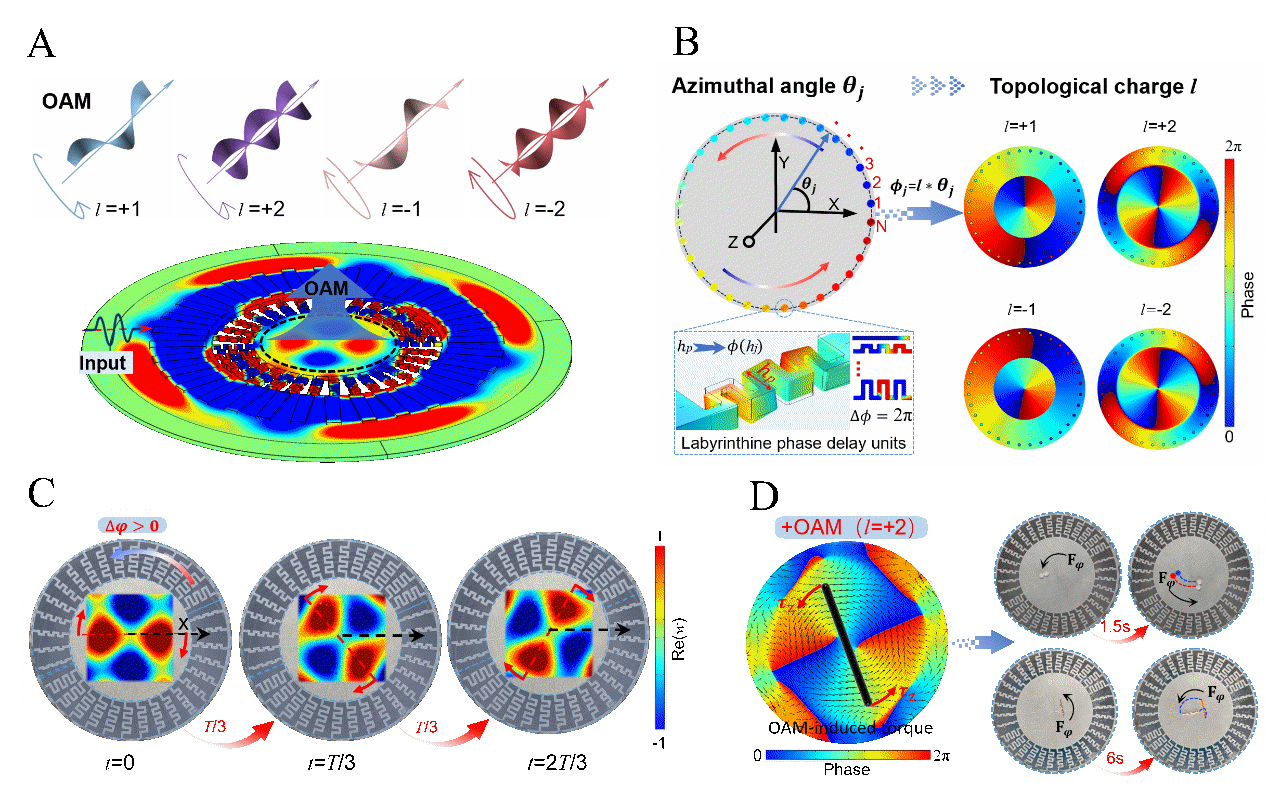
Passive structure-encoded flexural-wave vortex generation and surface object manipulation. (Image by the research team)
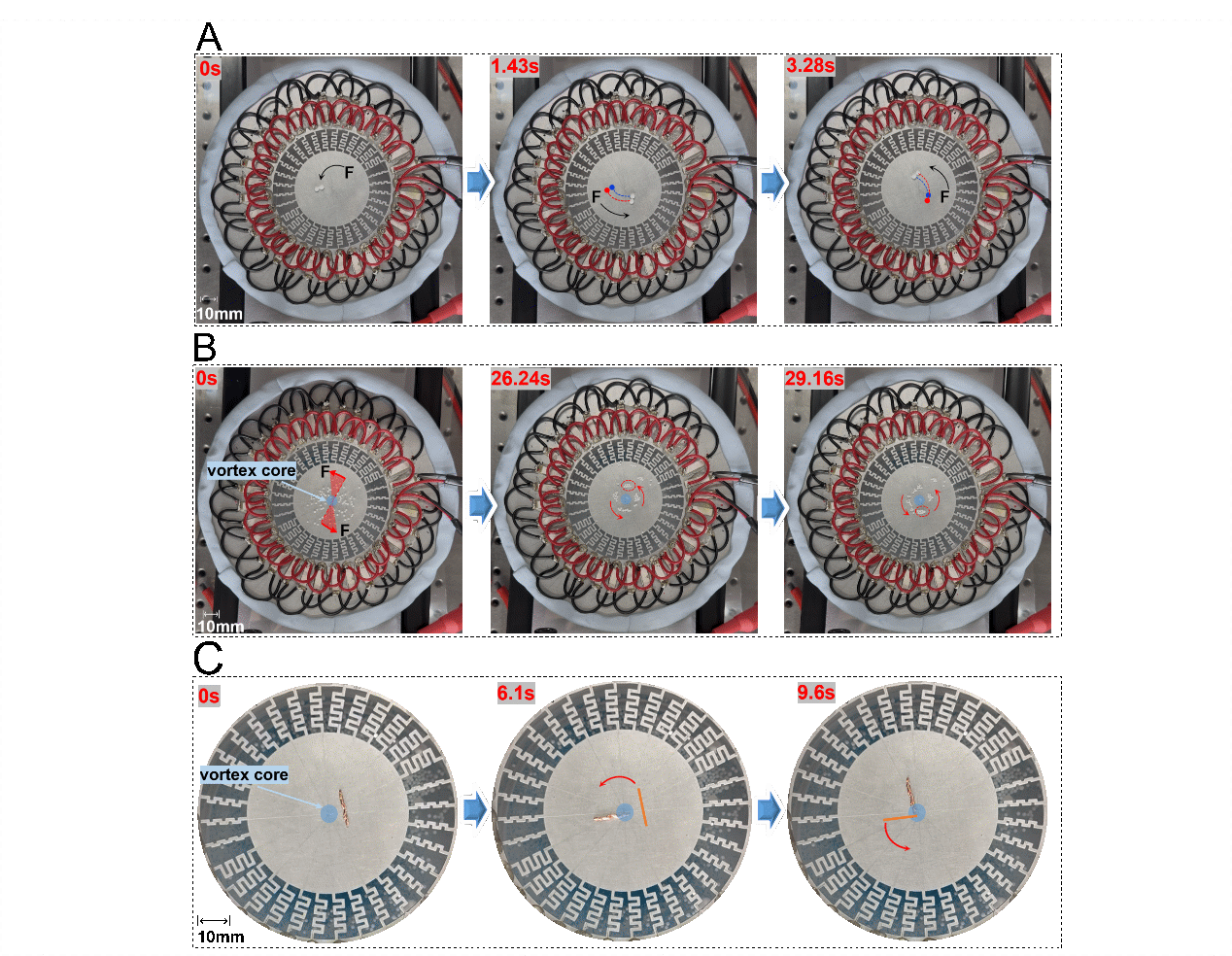
Cross-scale surface object manipulation using flexural-wave vortices. (Image by the research team)
Reference:
Zeyang Bi, Zhiqiang Li, Yunkang Ren, Yugui Peng, Xuefeng Zhu, Liuxian Zhao, Jun Yang, Chuanxing Bi. Passive Metasurface Tweezers for Multi-Scale Orbital Transport and Trapping on Elastic Plates. Advanced Science (2026): e77631. https://doi.org/10.1002/advs.77631
Contact:
ZHOU Wenjia
Institute of Acoustics, Chinese Academy of Sciences, 100190 Beijing, China
E-mail: media@mail.ioa.ac.cn